Sunday, February 25, 2007

One Character Foods

Other matters are demanding my attention right now. So this post will have to be lighter than the first dozen. A sorbet, if you will.

The challenge is to find food words of only one character. Character needs to have the very specific technical interpretation of assigned code in Unicode 5.0. Word means something that would have an entry in a dictionary.

Read More

Listing all these words would be hopelessly tedious. So the actual challenge is to find interesting new examples for categories of one character words. In general, one example per script group.

The biggest source is the Unified Han characters. So, just by way of a concrete example, take U+98EF 飯 'cooked rice; dish; meal'.

Some of the early mostly phonetic scripts still had a few ideograms. For example, Linear B has a handful, such as U+1008E 𐂎 'wheat'.

Unicode has some ranges of symbols, mostly for compatibility with other encoding standards. The closest to a food I can think of from Miscellaneous Symbols is U+2615 ☕, which is meant to be 'coffee' or 'tea', depending on which side of the Atlantic you are on, but might just be 'soup'. Any better suggestions? What about other symbol groups? Is there a better example from the Yijing than U+4DDA ䷚, the open mouth?

Some scripts assign code points to syllables. The most obvious example would be Hangul and Korean has many one syllable words. To be concrete, take U+BC25 밥 bab, which again means things like 'cooked rice', as in 비빔밥 bibimbap. (Bibimbap traditionally has meat in it, but Korean restaurants around here offer vegetarian versions; Wikipedia even says that might be the original. Those three syllables also share just the right number of sounds to show off just how elegant the Hangul writing system is.) What about other syllabic scripts, like Ethiopic? Are there any one syllable food words in Ge'ez or Amharic?

In general, Unicode does not encode ligatures, since, like fonts, they relate to rendering. But again some result from needing to offer reversible transcoding with other standards. In particular, there are three-letter Arabic ligatures in the U+FD50-FDC7 range. Are any of the ones of those that work in isolation food words?

Single letter conjunctions, copulas and prepositions are not hard to find, but what about food nouns? Diacritics are allowed, of course, provided Unicode offers a composed character with them. vdict.com says that é (U+00E9) is a regional word for húng 'basil'.

I am disinclined to allow abbreviations. So, I do not think that the L in BLT counts; too much context is required. (Of course, around here it's VLT, which the editorial review for this book says is made with fried leeks.) Nor longer ones like trying to have U+FB00 ff stand for French Fries.

Leave a comment with additions or improvements. With luck, I'll have time for a more interesting post next time.

Sunday, February 18, 2007

Paneer

I imagine most everyone has had the experience of discovering a word or phrase for the first time and then immediately finding it in use in books, magazine articles and party conversations. Some of the time it really is brand new and some of the time it just didn't get remembered quite right. A related phenomenon is believing that one basically knows all the contexts and associations only to discover and keep discovering that it is much more prevalent than one imagined.

That is what happened with paneer.

Read More

I have been eating paneer dishes for as long as I have been eating Indian food. Most often as Saag or Palak Paneer. (These names are more or less interchangeable around here. पालक pālak is spinach specifically; साग sāg is various similar leafy vegetables, and so could include ones like mustard greens. But it never seems to in restaurants. Those are the common spellings, despite the inconsistent treatment of the long vowel.)

Commercial paneer is available in the cheese aisle at the regular supermarket these days. But it is fun and not at all hard to make and we used to do it all the time when we did more cooking. Boil milk. Add lemon juice. Strain in cheesecloth. Press under a weight.

And I have long known more or less what the Wikipedia and OED say, that paneer comes from Persian. With that much protein, it is the food of wealthy vegetarians. Shahi Paneer Korma is a Mughal court dish. (शाही shāhī 'royal' from Persian شاه shāh 'king; Shah' from Old Persian xšāyaθiya — as in 𐎠𐎭𐎶𐏐𐎭𐎠𐎼𐎹𐎺𐎢𐏁𐏐𐎧𐏁𐎠𐎹𐎰𐎡𐎹𐏐𐎺𐏀𐎼𐎣𐏐𐎧𐏁𐎠𐎹𐎰𐎡𐎹𐏐𐎧𐏁𐎠𐎹𐎰𐎡𐎹𐎠𐎴𐎠𐎶𐏐 adam Dārayavauš xšāyaθiya vazạrka xšāyaθiya xšāyaθiyānām 'I am Darius, great king, king of kings' — cognate with Sanskrit क्षि kṣi 'to rule' whence क्षत्रिय kṣatriya the Kshatriya warrior caste. कोर्मा kormā from Turkish korma from a Turkish root *KAgur meaning some way of cooking.)

But I never managed to extend this much in space, time or semantics.

پنیر panīr is the regular Persian word for 'cheese', though I don't recall ever seeing a dish with that in the name at a Persian restaurant. Of course there are simple traditional cheeses (suitable for political photo-ops — cf. this), but in the modern cosmopolitan environment, it's just as likely to be pizza topping or Swiss Cheese. This point was driven home while looking through آموزش آشپزی گياهی Amuzash-i ashpazi-i giyahi 'Instruction in Cooking Vegetables'. There is a recipe for پنیر كُورد panīr kūrd (Curd Cheese), including that English gloss. The recipe is more or less the one I gave above for paneer. (Well, it calls for لیمو ترش līmū-tursh 'sour lemon', which might well be 'lime'. The distinction between these two citrus is by no means firm in any language.) An English word is borrowed to qualify a home-made پنیر panīr for modern Iranian vegetarians that American or British home cooks might well have called paneer, since Indian-style home cooking is a more popular import than Persian-style. (I imagine Jamie Oliver has a recipe for paneer on one of his shows or in one of his books.)

This has me paying closer attention.

Reading The Lake Regions of Central Africa, Burton of course has much to say about the native cuisine. But in particular for this topic, he mentions (p. 52),

The mutunguja (the Puneeria coagulans of Dr. Stocks,) a solanaceous plant, called … by the Baloch panír, or cheese, from the effect of the juice in curdling milk, …
and again (p. 464-5),
Milk is held in high esteem … mtindi (curded milk), the laban of Arabia, and the Indian dahi. … [T]hey consider cheese a miracle, and use against it their stock denunciation, the danger of bewitching cattle. The fresh produce, moreover, has few charms as a poculent among barbarous and milk-drinking races … On the other hand, the curded milk is every where a favorite … [They] do not … make their dahi …, like the Arabs, with kid's rennet, nor like the Baloch with the solanaceous plant called panir.

Much of this is the usual Victorian racism, though the notion of milk-drinking races survives a bit in the conclusion that a difference between cheese and tofu cultures is genetic lactose intolerance in Asia. The observation here is that there is a plant called panīr used as a vegetable rennet. Vegetable rennet is important to lacto-ovo vegetarians. It can be tricky to discover how the cheese in prepared cheese foods was made and the conservative assumption always has to be that “enzymes” means animal rennet. Commercial vegetarian rennet is made from molds, but there are plant alternatives.

I recently found a copy of Souvenir of the XVth World Vegetarian Congress, India, 1957 in an online used bookstore. But it seems to have gotten lost in transit. In trying to track down another copy (and not succeeding), I discovered that most of it has been scanned or transcribed online. One of the tables is "BEST" PROTEIN OR BODY-BUILDERS TABLE (makes me think of Jack LaLanne), which has a footnote mentioning, "The Imperial Dairy Institute Bangalore, discovered a vegetable rennet in the Withania Coagulanas berry, but this not in use commercially." (Typos probably only in the website transcription.) More on this plant (Withania coagulans) can be found in this notice, which references this report.

Still not much of a stretch in meaning.

Then over the weekend we went to the Armenian markets in Watertown, to get some tahini bread for my wife's breakfast and because the selection of vegetarian items increases as lent approaches. (The only Armenian vegetarian cookbook in WorldCat is a Lenten cookbook.) Looking through the cheeses, there was Armenian String Cheese and Piknik White Cheese. And for the first time I paid attention to these being labeled “ՀԻՒՍՈՒԱԾ ՊԱՆԻՐ” hiwsuac panir and “Փիքնիկ-ի Պանիր” p'iknik-i panir. պանիր panir is 'cheese'. And then the equally obvious connection that all the Turkish cheeses there labeled “peynir” or “peyniri.” (The vegetarian choices among the “Turkish Pizzas (Pideler)” at the local Turkish restaurant are both Peynirli Pide 'cheese pita'. I just didn't make these connections.)

Of course the dictionary confirms that պանիր panir and peynir are the basic words for cheese. The Turkish dictionary offers a proverb,

peynir ekmek, hazır yemek. 'cheese bread, ready food' "One can always make a meal of bread and cheese alone."
And the Armenian Proverbs Wikiquote page another,
Որտեղ հաց, այնտեղ կաց:
Որտեղ պանիր, այնտեղ բանիր:
Vortegh hats, ayntegh kats.
Vortegh panir, ayntegh banir.

Wherever there's bread, stay there.
Wherever there's cheese, work there.
This second one also shows a problem with Armenian transliteration. Պ is [b] in Western Armenian, so one is just as likely to encounter banir for պանիր. Absent enough context, that might be another word.

Now I need to look into the origin some more.

As now expected, it is pretty widespread in Northwestern Asia. Hindi पनीर panīr; Urdu, Persian پنیر panīr; Marathi पनेर panēra; Punjabi ਪਨੀਰ panīr; Bengali পনির ponir; Balochi phaner (N) or panere (S); Pashto پنېر paner; Kurdish penîr or په‌نیر  phenir; Azerbaijani pendir; Turkish peynir; Turkmen peýnir or пейнир peĭnir; Armenian պանիր panir.

An important word with an interesting distribution like this invites various fanciful origin theories. So it does not take much effort to find sci.lang posts proposing (and correcting) the idea that peynir is one of a number of Turkic words in Indic languages. Or a book claiming that panir is named after the Panis of the Ṛg-Veda who first made it.

This page says that panir is mentioned in the Bhagavata-purana (भागवत पुराण). Even ignoring the traditional date for the Puranas of several millenia BCE, a more conservative one of the tenth century might be significant. But all that really seems to be there is various older milk-derived products, दधि dadhi 'curds; yogurt' — the dahi quoted above, क्षीर kṣīra 'thickened milk' and घृत gṛta 'ghee'; and cooking पयस् payas 'milk' to make them. For instance, in Chapter 10, so important to Kṛṣṇa devotees,

गोपाः परस्परं हृष्टा दधिक्षीरघृताम्बुभिः आसिञ्चन्तो विलिम्पन्तो नवनीतैश्च चिक्षिपुः
gopāḥ parasparaṃ hṛṣṭā dadhi-kṣīra-ghṛtāmbubhiḥ āsiñcanto vilimpanto navanītaiś ca cikṣipuḥ (10.5.14)
In gladness, the cowherd men enjoyed the great festival by splashing one another's bodies with a mixture of curd, condensed milk, butter and water. They threw butter on one another and smeared it on one another's bodies. (tr. Bhaktivedanta)
and
उत्तार्य गोपी सुशृतं पयः पुनः प्रविश्य संदृश्य च दध्यमत्रकम भग्नं विलोक्य स्वसुतस्य कर्म तज्जहास तं चापि न तत्र पश्यती
uttārya gopī suśṛtaṃ payaḥ punaḥ praviśya saṃdṛśya ca dadhy-amatrakam bhagnaṃ vilokya sva-sutasya karma taj jahāsa taṃ cāpi na tatra paśyatī (10.9.7)
Mother Yaśodā, after taking down the hot milk from the oven, returned to the churning spot, and when she saw that the container of yogurt was broken and that Kṛṣṇa was not present, she concluded that the breaking of the pot was the work of Kṛṣṇa. (tr. Bhaktivedanta)

It's possible, maybe even likely, that something like paneer was within the intended description of 'curds'. But there's no sign of the word paneer yet. So a Persian origin remains.

Panīr is present in Pahlavi. There is no Unicode support for the script yet, but here is a poem containing pnylpnyl twice.

Attention to Persian etymology appears to have some gaps. Garnik Asatrian (Գառնիկ Ասատրյան), the head of Iranian Studies at Yerevan State University is working on An Etymological Dictionary of the Persian Language, which makes sense since there are lots of early connections between Persian and Armenian. The Этимологический словарь иранских языков Etimologicheskij slovar’ iranskikh jazykov 'Etymological Dictionary of the Iranian Languages', which covers a wider scope of languages, has published two fascicles so far, a-ā and b-d. In the meantime, the standard works are still by Paul Horn from the 1890s, Grundriss der Neupersischen Etymologie and Persische Studien. These have even been translated into Persian and are still in print as آساس اشتقاق فارسي Āsās-i ishtiqāq-i Fārsī.

Grundriss section 163 (p. 289) is *pēm 'milk'. This gives Avestan payah-, cognate with Sanskrit पयस् payas quoted above, and already missing in Pahlavi. پینو pīnū is 'sour milk' and so پنیر panīr 'cheese' and the related forms in Pahlavi, Kurdish, Pashto, Balochi, etc. Studien adds (p. 140. n. 1) Armenian պանիր panir from the 5th century.

Through the PIE root *peiƏ, a couple more 'milk' words are related, Lithuanian píenas and Latvian piẽns. The more general sense of the root is 'be fat'. Some of the descendants of the root that make it into English are thus fat, pituitary, and Irish.

Now I have a sense of how much broader the connections are than before I started looking beyond what I thought I knew.

Sunday, February 11, 2007

Kamut

My wife likes variety in her breakfast. So we have a box of Kamut Flakes on the kitchen table. The back of the box says, "Cereal of the Pharaohs", and the front,

KAMUT (kah-moot), the "Great Grandfather of Grains".
Derived from the ancient Egyptian word for "Wheat", this high-energy grain was discovered thousands of years ago.
Never mind coordination problems in the telling, there are stories of the origin of the food and its name here.

Kamut® is a trademark for cultivar QK-77 of Khorasan wheat, owned by the Quinn family and their company. It is also a Protected Plant Variety (8900108), which allows control of seed distribution under any name. As its website admits and the Wikipedia page explains, it does not descend from a few grains preserved for millennia in a sealed tomb, but from some relatively isolated Middle Eastern crops that were introduced to the North American plains around WWII.

The major divisions of wheat (Triticum spp.) are:

  • Einkorn (T. monococcum), a diploid species that was cultivated early on.
  • Emmer (T. dicoccon), a cultivated tetraploid species from Wild Emmer (T. dicoccoides), a wild hybrid of two other diploid species.
  • Durum (T. durum), another tetraploid species from Wild Emmer.
  • Spelt (T. spelta), a hexaploid species, hybridized under cultivation from Emmer or Durum and some wild diploid species.
  • Common wheat (T. aestivum), another hexaploid species.

Khorasan wheat is tetraploid like durum and has been variously classified as T. polonicum, T. turgidum, and now T. turanicum. (All these tetraploid species are sometimes considered subspecies of T. turgidum.) Here is a diagram of the genealogy. Looks like it's the Uncle of Grains (on the web, it was "Great-Great Grandfather"). It is also known as Oriental wheat; in Chinese, 杂生小麦 za2 sheng1 xiao3 mai4 'mixed breed wheat'; in Russian, пшеница туранская pshenitsa turanskaia 'Turanian wheat'.

Further color to the story is supplied by the article “Kamut: A New Old Grain” in Gastronomica. This article can be purchased online as a DRM-encumbered PDF for $12. But that is the cover price of the whole magazine. Fortunately, the MIT Press bookstore (at once one of the nerdiest and one of the hippest bookstores in Boston) has just started to stock Gastronomica, including some back issues. (The article incorrectly states that the protection certificate lasts for sixteen years, and so expired in 2006; it lasts for eighteen years until 2008.)

According to the article, Khorsan wheat came to the US in 1949 with an Air Force pilot from Montana. It cites a 1964 Great Falls Tribune article claiming that “King Tut's Wheat” was found by a Montana farmboy in a tomb in Dahshur and miraculously germinated.  The Gastronomica author finds a Harvard paleobotanist to point out that grain does not last for thousands of years. Of course, this is an old story. For example, on Dec. 8, 1930, Time magazine had an article that mentioned seeds taken from the tomb of Tutankhamen when it was opened in 1922 and sent to Alberta in 1926 and just then (1930) harvested into a few bushels of "King Tut Wheat." And so is the debunking. On Dec. 29, Time ran a letter to the editor that prompted someone to ask the NYBG and get an expected grain lifetime of seven years.

I am more curious about the etymology than marketing hyperbole. Older marketing literature claims that it means “Soul of the Earth,” and relatively recent materials for products or from distributors repeat this claim (along with the fanciful timeline). However, the current trademark page comes right out and says that it comes from looking up 'wheat' in Budge's An Egyptian Hieroglyphic Dictionary and shows a scanned image of the dictionary entry. Part of the same scan showing the hieroglyphic headword appears elsewhere on the site. The Gastronomica article adds a couple of parenthetical details: this was the only Egyptology book in the Great Falls public library (actually, it's easy to find out that they don't have a copy of that book and that they do have others that are old enough to have been on the stacks in 1987, so perhaps it's some other library) and Budge's 1920 work is no longer considered reliable.

Read More

Dover Publications reprints a number of works of obsolete philology, like Budge and Wieger, cheaply (even more cheaply right now while their bestsellers are on sale) because they are out of copyright. Budge is a problem for real Egyptologists; he was behind the times even in his own day and by now they are likely to dismiss him as worthless. But because these editions are so cost effective and so widespread, everyone with any interest in the area will have encountered them. If one gets more serious, there is some unlearning to be done. I got a copy of Gardiner's Egyptian Grammar right away when I got to college, but maintain an affection for the books I had growing up. Moreover, lots of these Dover works can be studied in their own right for a perspective into the late British Empire. In particular, their recent reprint of The Nile, which Budge did for Thomas Cook so that young ladies traveling to Egypt would have an educated companion, is quite entertaining in that way.

Composing text in any different script used to be a significant undertaking before Unicode, with custom fonts and encodings. But Unicode support for Egyptian hieroglyphs is still working its way through proposals and committees. So putting them in a blog post means using images. But even that has gotten comparatively painless. There are programs to do the composition and rendering starting with Manuel de Codage format, standalone or within PHP; there is even a site to do it all remotely. +s k-A-m-w-t:t-M2:Z2-! gives k-A-m-w-t:t-M2:Z2 and we're in business.

The Budge dictionary entry reads:

kamut k-A-m-w-t:t-M2:Z2, Hh. 457, D28-m-t:Y1-Z3, D28*t:Y1-m-M33:U9, wheat, grain; Heb. קָמַת (?); k-A-Aa15:t-w-N18:Z2-M33\t1-U9:Z2, k-A-Aa15:t-w-N18:Z2, wheaten bread.
The phonetic part is the same; the determinatives are M2 'plant', M33 'grains', U9 'pouring grain', N18 'cake' (in one of its variants).

Hh. stands for Text of Ḥer-ḥetep, Maspero, “Trois Années de Fouilles”, Mémoires de la Mission Archéologique Française au Caire (1884). Unfortunately, this does not seem to have been digitized online yet.

Hebrew קָמַת qamaṯ is 'stalk of grain', for instance in Deuteronomy 23:26 (23:25 in KJV where 23:1 is 22:30):

כִּי תָבֹא בְּכֶרֶם רֵעֶךָ וְאָכַלְתָּ עֲנָבִים כְּנַפְשְׁךָ שָׂבְעֶךָ וְאֶֽל־כֶּלְיְךָ לֹא תִתֵּֽן׃ ס כִּי תָבֹא בְּקָמַת רֵעֶךָ וְקָטַפְתָּ מְלִילֹת בְּיָדֶךָ וְחֶרְמֵשׁ לֹא תָנִיף עַל קָמַת רֵעֶֽךָ׃
kî ṯāḇō’ bəqāmaṯ rē‘eḵā wəqāṭap̱ətā məlîlōṯ bəyāḏeḵā wəḥerəmēš lō’ ṯānîp̱ ‘al qāmaṯ rē‘eḵā
When thou comest into the standing corn of thy neighbor, then thou mayest pluck the ears with thine hand; but thou shalt not move a sickle unto thy neighbor's standing corn.

A more modern transliteration of k-A-m-w-t:t-M2:Z2 is k3mwtt (I am going to follow Allen, but with 3 for aleph, because it renders reasonably in HTML). This word is not in Faulker. But it is online in the Thesaurus Linguae Aegyptiae, which has "Ähre (der Gerste)" and a reference to page 106 of the Wörterbuch der Ägyptischen Sprache, which has "belegt Totb. M.R.; Königsgr. Bez. für Gerste. auch Bier daraus." In other words, while this could be 'grain' generally, it is 'barley' specifically. It is not certain that Khorasan wheat was grown in a place and time where Egyptian was spoken and probably impossible to know what it was called there if so.

קָמַת qamaṯ is from the root קום qwm 'rise'. There is also kA-m-w-M34-O1 k3mw 'vineyard' like כֶּרֶם kerem. The BPL has Etymological Dictionary of Egyptian as published so far, but it's a many volume effort that isn't up to that sound yet. Here is a list of Afro-Asiatic cognates including k3mwtt, such as Pero koomo 'maize' and Nzangi kʷǝmǝ 'corn'.

Budge has a dozen words indexed under 'wheat'. Presumably Quinn picked the one that sounded best for a trademark or maybe just the last one, closest to the index. It is worth having a look at some of these and some related words nearby in the semantic space. The table gives Budge's definition (plus glosses in brackets) and more modern ones, so it also gives a sense of how accurate the old source is in this quite limited area.

i-t:M33ȧtcorn, grist; Copt. ⲉⲓⲱⲧ ['barley'].
jtbarley; corn in general.
b-d:t-M34beṭ-tspelt, millet, dhurra, barley; Copt. ⲃⲱⲧⲉ ['emmer'].
bdtemmer.
z-w-t:M33su-twheat, corn, grain; Copt. ⲥⲟⲩⲟ ['corn, wheat'].
zwta kind of emmer.
s-w-t:M33su-tcorn, grain, wheat; Copt. ⲥⲟⲩⲟ, ⲥⲟⲩ.
swtwheat.
q-m-H-w-X2qemḥubread made with fine flour; compare Heb. קֶמַח [qemah 'flour' e.g. Gen. 18:6], Arab. قَمْح [qamh 'wheat'], Syr. ܩܲܡܚܳܐ [qamhā’ 'flour'], Eth. ቀምሕ፡ [qamḥ 'fruit; leguminous plant'].
qmḥwa kind of bread.
x:n:d-U10khenṭwheat; Heb. חִטָּה [ḥiṭṭāh 'wheat' e.g. Deut. 8:8], Targ. חִנְטָא [ḥinətā’], Arab. حِنْطَة [ḥinṭa 'wheat'].
ḫndkind of cereal? millet? This article also seems to mention this, but I don't have access to a copy.

Returning to k-A-m-w-t:t-M2:Z2 k3mwtt, as the newer dictionary entries indicate, the word is used in the Book of the Dead and royal tombs. In particular, in the Amduat, a story of the journey of the sun god through the twelve hours of the netherworld. Here again, there is a modern synoptic edition, Texte zum Amduat, in larger libraries (the MFA library, which is open to the public, has it, but it would take a few days to get over to Horticultural Hall from the Egyptology Department), and Budge's Egyptian Heaven and Hell, which is much easier to find and even online. (A small press translation with autograph hieroglyphic text is also online in PDF form.)

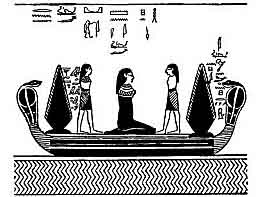
In the Second Hour of the Amduat (Y1:t*Z1-V12-i-Z11-m-N14-A-t:O1 mḏ3t-jmj-dw3t 'Book of Things in the Netherworld'), the sun god's boat travels through a region known at Wernes (wr:r-n:z:S wrnz), where the fourth boat encountered is that of the grain god Neper (n:p:r-M33\t1-A40 npr), bearing an armless goddess flanked by two armless gods. In the stern of the boat is a giant ear of grain with legends i-A-t:k-A-m-w-t:t-M2:Z2 j3t-k3mwtt 'staff of grain' and R12-k-Aa15-t:t. The online text of this chapter does not have the hieroglyphic text for that particular section, just Budge's translation "collector of herbs and plants." And the picture is a little hard to make out; the columns in question are between the left-hand ear and the god facing right. Budge's text comes from Lefébure's copy from the tomb of Seti I (KV17). Thanks to the Theban Mapping Project, here is a photo of the original text online. The word kamut written in context three thousand years ago without leaving the breakfast table.

Sunday, February 4, 2007

Mooli

Several of the local Indian restaurants regularly feature Mooli Paratha on the specials menu. I do not recall one that has it on the regular menu, but the well established notion of standing specials seems just as good. It makes for a nice break from the more common Aloo (Potato) and Gobi (Cauliflower).

A typical menu gloss is, “flaky bread stuffed with radish.” There is nothing wrong with this, but I think a more descriptive version would be “… with daikon.” Daikon is what large white radishes are called in supermarkets, at least here in the Northeast. There is no fundamental basis for this priority that one could predict, it could have gone the other way; just as okra might have ended up being known as bhindi or bamia. I wonder whether it is ever reversed in Britain. I believe mooli is in the OED and daikon is not. The BBC has two essentially identical entries. Has a menu or restaurant review ever referred to “Japanese style mooli”? What about Raj travelers to Japan?

As expected, the Wikipedia Daikon entry provides some synonyms for Japanese 大根 daikon, such as Chinese 白蘿蔔 bai2 luo2bo2 and Korean 무 mu. And the M.M.P.N.D.'s Raphanus page has even more, such as Hindi मूली / Urdu مولى mūlī, which got me started, Vietnamese củ cải, Thai หัวผักกาดขาว hŭa-pàk-gàat kăao. Of additional interest is an extended discussion of the taxonomy problems that radish presents. The author "refuse[s] to believe that the true Japanese daikon is the same as the 'Black Spanish winter radish' or the 'Chinese long green radish'" and explores several alternative ways of categorizing. At another end of the debate is the cited Northern Ontario Plant Database entry, which equates pretty much everything.

Read More

मूली mūlī comes from the Sanskrit मूल mūla 'root' (in most senses, including 'origin' and वर्गमूल vargamūla 'square root'). 大根 daikon means 'big root'. Many European radish words, such as French radis, come from Latin radix 'root'. English radish is from Old English rǽdic, just as German Rettich comes from Middle High German retich from Old High German rátih, both from that same Latin root radic-. (From here on, feel free to assume that every use of root to mean lexical source is an intentional pun.)

मूलक mūlaka is Sanskrit for 'radish'. Tamil has மூலம் mūlam  முள்ளங்கி muḷḷangki 'radish'. If the borrowing is Tamil to Sanskrit, then it is presumably a Dravidian root. If the other direction, an Indo-European root, given by Pokorny as *mū-lo- 'root; plant', is viable. This also gives Greek μῶλυ, the magical plant of which Homer writes,

μῶλυ δέ μιν καλέουσι θεοί: χαλεπὸν δέ τ' ὀρύσσειν
ἀνδράσι γε θνητοῖσι, θεοὶ δέ τε πάντα δύνανται. (Odyssey 10:305)
Moly the name, to mortals hard to find,
But all is easy to the ethereal kind. (tr. Pope)
In later works, μῶλυ, like μώλυζα, is a glossed as σκορόδων 'garlic'. Ancient Greek for 'radish' is ῥαφανίς, related to ῥάφανος 'cabbage', whence the generic name Raphanus. This gives Modern Greek ρεπάνι and a few other European 'radish' words like Portuguese rabanete, diminutive of rábano, cruciferous plants in general.

Not surprisingly, other Indic languages have the mūla root: Bengali মুলো mulō; Marathi मूलक mūlaka; Nepali मुलो mulo; Punjabi ਮੂਲੀ। mūlī.

Dictionaries give Persian تربچه torobcheh; Arabic فجل fujl — Lane quotes one of his source dictionaries are saying it is not a genuine Arabic word; Tibetan ལ་ཕུག་ la-phug — also used to translate मूलक mūlaka in the religious sense that we will get to below.

Thai หัวผักกาดขาว hŭa-pàk-gàat kăao appears to mean 'white turnip', but its use for daikon is confirmed by online recipes. Other dictionaries give หัวไชเท้า hŭa-chai-táo 'radish'. The other translations given on the M.M.P.N.D. page for different regions of the country seem to be made up of the same roots rearranged. I believe หัว hŭa is 'head' and ผัก pàk is 'vegetable'. The Wikipedia gloss for 白蘿蔔 bai2 luo2bo2 'white carrot' doesn't quite feel right; 蘿蔔 luo2bo2 (Simplified: 萝卜; sometimes encountered in English as lobok from Cantonese) alone seems to mean 'radish' and 紅蘿蔔 (Simplified: 红萝卜) hong2 luo2bo2 'carrot' adds the 'red' character. Of course, carrots come in many colors; the predominance of orange is due to selective breeding by Dutch patriots. To return from carrots (a subject for another post) to mooli, here is a joke (from among other places here; there do not seem to be enough variations online for it to be well-known and not original to one of the pages):

… One english tutor was heard telling his pupil that … ‘Mooli’ is ‘carrot’. The mother of the student overheard and came in and asked ‘Isn’t Mooli radish ?’ To which the embarrassed teacher replied ‘Yes, yes, Mooli is sometimes reddish and sometimes whitish.’

There is nothing wrong with writing Sanskrit in transliteration. The Clay Sanskrit Library, the Sanskrit equivalent of the Loeb Classical Library, publishes the left-hand pages that way. The biggest advantage of Devanagari on the web is that it avoids having to figure out which of many competing transliteration schemes is in use, particularly for single words. Slightly different schemes would also seem to make proofreading source texts harder and I imagine it is already hard enough. Another issue is how much of the sandhi to reverse to facilitate word search. The CSL has a complex scheme that allows for unambiguous recovery of the underlying form. Online documents seem to do similar things, but not always consistently. None of this makes reading that much more difficult. But combined with the rich morphology, it makes searching hard. Even if all the documents are gathered into a single corpus with a consistent format, I assume it is challenging. But things are actually scattered, so something like a conventional search engine is needed, but Sanskrit-aware. Not surprisingly, one can quickly find mention of related projects underway, such as at TDIL and INRIA. I look forward to their bearing fruit and being generally available.

Sometimes मूलक mūlaka just means 'root'. For instance, searching for मूलकं mūlakaṃ, one of several obvious sandhi forms, finds Mahābhārata (महाभारत) 13:112.98:

फलं वा मूलकं हृत्वा अपूपं वा पिपीलिकः
phalaṃ vā mūlakaṃ hṛtvā apūpaṃ vā pipīlikaḥ
stealing seeds or roots or cakes [one becomes] an ant
This is from a very long litany of negative rebirths depending on what one steals.

For some reason, the Sanskrit source given in Platts for मूली mūlī is मूलिका mūlika 'collection of roots'. For example, the 108 roots used at the coronation ceremony for the king of the birds in the Crows and Owls (काकोलूकीयम् kākolūkīyam) chapter of the Panchatantra. This text is online in Wikisource, one of the very few Google hits for मूलिका mūlika. Unfortunately, there seems to have been some corruption in transferring the text, with part missing and a nukta on a ḍa.

अथ साधितॆ विविध-तीर्थॊदकॆ, प्रगुणीक्ड़्तॆष्टॊत्तर-शत-मूलिका-संघातॆ प्रदत्तॆ सिम्̣हासनॆ, …
whereas another edition gives:
अथानीतेषु तीर्थोदकेषु प्रगुणीकृते च चक्राङ्किता-सहदेवी-प्रभृत्य-अष्टोत्तरशत-मूलिका-संघाते
athā–nīteṣu tīrthodakeṣu, praguṇīkṛte ca cakrāṅkitā-sahadevī-prabhṛty-aṣṭottaraśata-mūlikā-saṁghāte, …
Straightway water was brought from various holy streams; a bouquet of one hundred and eight roots was provided, including the one marked with a wheel and the yellow-stemmed lotus; … (tr. Ryder)
The Wikisource page was submitted anonymously, so it is hard to trace where it might have come from.

The same Platts entry says that मूली mūlī is used metaphorically for something worthless, presumably because it is commonplace food. Ayurvedic dietary principles divide foods into sattvic (सात्त्विक sāttvika 'vigorous'), rajasic (राजसिक rājasika 'passionate') and tamasic (तामसिक tāmasika 'dark'). Radish is considered tamasic; so, like onions and garlic, it is forbidden in a pure sattvic diet, one of the closer traditional analogues to vegan.

The radish is associated with Gaṇeśa (गणेश), the elephant-headed god. Here is a news story about an auspicious radish shaped like Gaṇeśa. Mūlaka (मूलक) 'radish' is one of His attributes. In contemporary theology, this is explained as being one of His favorite foods; for example, in this devotional book. The history of this iconography is more complicated. In particular, the relationship between mūlaka and another of Gaṇeśa's attributes, bhagnadanta (भग्नदन्त) 'broken tusk'. The essential question is whether these two are really the same, and if so, which came first. Here are some of the main points, which are not entirely consistent, from Gaṇeśa by Alice Getty (1936), Ganesh: Studies of an Asian God edited by Robert L. Brown (1991) and Gaṇeśa: Unravelling an Enigma by Yuvraj Krishan (1999):

  • Though the particular combination of attributes held varies, the radish and the tusk never occur in the same statue / image.
  • Gaṇeśa is almost always portrayed as ekadanta (एकदन्त) 'one toothed'.
  • The stories of how one tusk came to be lost always have it broken off, not pulled out, so there is no accounting for any roots being attached.
  • Sometimes the object clearly does have something sprouting out of the end like roots or leaves and must therefore be a radish.
  • The Yājñavalkyasmṛti (याज्ञवल्क्यस्मृति) from about 300 BCE lists some suitable offerings to Vināyaka (विनायक 'remover of obstacles'), originally a tantric demon that came to be considered another aspect of Ganesh:
    पुष्पं चित्रं सुगन्धं च सुरां च त्रिविधाम् अपि मूलकं पूरिकापूपांस तथैवोण्डेरकस्रजः
    puṣpaṃ citraṃ su-gandhaṃ ca surāṃ ca trividhām api mūlakaṃ pūrikā1pūpāṃs tathaivoṇḍeraka-srajaḥ
    multicolored flower and perfume and three kinds of wine and moreover radish and cake and rolls on a string
  • A verse of the Bṛhat-Saṃhitā (बृहत्संहिता), written by Varāha-Mihira (वराहमिहिर) around the end of the fifth century CE reads:
    प्रमथाधिपो गजमुखः प्रलंबजठरः कुठारधारी स्यात् .
    एकविषाणो बिभ्रन्मूलककन्दं सुनीलदलकन्दम्
    pramathādhipo gajamukhaḥ pralambajaṭharaḥ kuṭhāradhārī syāt
    ekaviṣāṇo bibhranmūlakakandaṃ sunīladalakandam

    The lord of the Pramathas is elephant-faced and pendent-bellied and perhaps bears an axe;
    he is one-tusked and carries a radish-bulb with dark blue leaves and roots.
    But since this verse is only in one version, it may be spurious. If not, it indicates that He holds a radish with something distinguishable at the end.
  • Getty says that the radish is not well known in India, but a favorite in Nepal, Tibet and Japan, suggesting a reinterpretation of the tusk there.
  • Getty's plate 16(d) is a statue from Dhānukā in Bengal with what is clearly a radish.
  • Getty's plate 35 shows a painted image from Endere (from Ancient Khotan vol. 2 pg. 167) with a white radish with green leaves.
  • The esoteric Vināyaka form of Gaṇeśa adopted in Japan carries a radish and is associated with hybrid legend involving a king (named Mararuratsu?) who only ate meat and radishes.
  • Brown says that the radish was actually quite popular in early Indian Gaṇeśa iconography and illustrates (his Fig. 11; another photo here) a seventh century Gaṇeśa from Benisāgar with three leaves pointing downward. He suggests therefore that the evolution might have been in the other direction.
  • Wilkinson (in Brown) translates several Kangyur texts related to Gaṇapati that describe Him holding a radish.
  • Sanford (in Brown) translates part of the Gaṇeśa entry in the Byaku hokkushō (白寶口鈔) of Ryōzen (亮禪) relating to the cannibal king of Marakeira who only ate beef and radishes.
  • Krishan quotes two Buddhist maṇḍalas from the Niṣpannayogāvalī that have Gaṇeśa holding a radish.

(If you know where any more of the images or source texts cited above are online, leave a comment and I'll try to add it in.)

Daikon is a commonplace foodstuff in Japan, which led to its place in the Zen aesthetic, both as a food and an object. Daikon was a popular subject for Zen ink paintings. An extremely eccentric version is 果蔬涅槃図 Yahai Nehan-zu 'Vegetable Nirvana (image)' by Itō Jakuchū (伊藤若冲) from around 1790. It portrays the paranirvana with vegetables as actors; in particular, a large daikon as the Buddha. An essay “Multiple Commemorations: The Vegetable Nehan of Ito Jakuchu” by Yoshiaki Shimizu in this book discussed this painting.

Jakuchū was the head of a fourth generation family greengrocery before becoming an artist full time. But the work still fits within the by then well established concept of 草木成仏 sōmoku jōbutsu 'plant buddha-nature'. This idea is further discussed here in relation to Nō plays and here and here in relation to the work of the poet Saigyō.

The question began in China and was furthered in Japan. There was an attempt to give it a scriptural basis in two ways. First, by a creative interpretation of the fifth chapter (ओषधीपरिवर्तः Oṣadhīparivartaḥ  藥草喻 yao4 cao3 yu4 On Plants) of the Lotus Sutra (सद्धर्मपुण्डरीकसूत्र Saddharmapuṇḍarīka-sūtra 妙法蓮華經 Miao4fa3 Lian2hua1 Jing1). This chapter is an extended Mahāyānist metaphor on the spread of Buddhist knowledge like rain vivifying plants. The new interpretation is that it literally proposes the spread to plants. Second, a new claim was made for the origin of the phrase:

一佛成道觀見法界
草木國土悉皆成佛
yi1 fu2 cheng2 dao4guan1 jia4 fa3 jie4
cao3 mu4 guo2 tu3xi1 jie1 cheng2 fu2
When one Buddha attains the Way and contemplates the realm of the Law
The grasses and trees and land will all become Buddha. (tr. Shively)
The claim is that it comes from 中陰經 Zhong1 yin1 jing1 / Chūingyō, the Chinese translation of Antarābhava sūtra. Apparently it does not, though the second half at least was very popular in Nō plays. (I know that makes it doubly bogus to give a modern Mandarin transliteration. But I just don't know enough to do a proper job of a Heian Japanese one and the alternative would be none. Interestingly enough, Google only finds the  phrase in this form on .tw sites concerned with ecology. .jp sites have the Japanese simplified character 観.)

Of particular importance was an imperial sponsored intersectarian debate known as the Ōwa no Shūron (応和の宗論) in 963 between Ryōgen (良源) of the Tendai (天台) sect and Chūzan (仲算) of the Hossō (法相) sect. Ryōgen carried the day, but Chūzan was remembered for the sophistication (or sophistry) of his arguments (as is required in any good religious debate). For example, in discussion of this phrase from the second chapter of the Lotus Sutra:

若有聞法者,無一不成佛。
ruo4 you3 wen2 fa3 zhe3, wu2 yi1 bu4 cheng2 fo2.
if there is anyone who hears the dharma, no one will fail to achieve Buddahood.
Chūzan argued that 無一 wu2 yi1 did not mean 'no one' as it appears but rather 'one with no [potential to achieve Buddhahood]'.

Sōmoku jōbutsu does not really touch on any kind of Pathetic Fallacy, because plants participate in the endless cycle qua plants, such as in their yearly growth and withering. Nor is their suffering the suffering of sentient beings (as might be of concern to readers of a vegetarian blog), but rather the metaphysical suffering of being trapped in this cycle, from which they may or may not be freed by the Buddha.

Here is a postmodern appropriation entitled 若冲(野菜涅槃図)Jakuchū (Yahai Nehan-zu) by Yasumasa Morimura (森村泰昌), whose work consists of inserting his own face onto famous works of art, such as Manet or Van Gogh. This is from his 日本美術史 Nihon Bijiyutsushi 'Japanese Art History' series. A Duchampian Buddhist daikon.

Finally, I believe it is just one of those language coincidences that a Mouli grater could be used as a Mooli grater to process daikon to make a delicious Indian bread.

Tuesday, January 30, 2007

Mary Chung's

I have been eating at Mary Chung's restaurant in Central Square, Cambridge for many years. Before the present 464 Mass Ave., across the street at 447. Before that, there was Colleen's at 792-794 Main St. (where Royal East is now) and Joyce Chen's Small Eating Place at 302 Mass Ave. (where Thailand Café is now). Chinese food is a well-established MIT tradition, as laid out in Steven Levy's Hackers (it has an index entry). Though, in keeping with the premise of his book, Levy sets up the associated study of restaurant Chinese as arcana rather than culture and blows the intellectual curiosity fueling it all out of proportion. (I appreciate that readers of this blog are essentially pre-selected for believing that an interest in the language behind one's food is reasonable, if not required.)

Learning some Chinese from / for menus is hardly restricted to LISP programmers. James D. McCawley's The Eater's Guide to Chinese Characters is roughly half reproduced menus and half dictionary with his own character indexing system. Ping-gam Go's Understanding Chinese Characters by their Ancestral Forms has glossy color photos of San Francisco's Chinatown and accompanying text to teach how to read them. Locally, the Mei Wah website has photos from around Boston, particularly Chinatown, again with explanations.

By their nature, menus do not have much grammar. No matter what the language: a complicated French dish might have a number of past participles and a few prepositions, but it does not narrate how the chef prepares it. So it is primarily a matter of learning some Chinese food words and the writing system used to present them. Which is why the titles emphasize Chinese characters.

These days we go there most Friday evenings, often for takeout. And often get the same dishes. Namely,

  • Refreshing Bean Sprouts — 涼拌豆芽 liang2ban4 dou4ya2.
  • Dun Dun Noodles — 擔擔麵 dan4dan4 mian4.
  • Ma Paw Tou Fu — 麻婆豆腐 ma2po2 dou4fu3.

The entrées are made vegetarian, obviously.

Read More

No single definition of 'word' works for all uses; there are whole books on the subject. But if taken to mean dictionary headword, that is, something that needs to be defined separately, then lots of Chinese words are made up of more than one character. The meaning of the word can be derived to varying degrees from the characters, just like etymologies is any other language. Most Chinese characters have two parts: a radical, which contributes a meaning in the sense of some kind of semantic category; and a phonetic part, which is related to a character that at one time sounded somewhat like the target. Chinese lexicography distinguishes between character dictionaries (字典 zi4dian3) and word dictionaries (辭典 ci2dian3).

Refreshing Bean Sprouts 涼拌豆芽 (Simplified: 凉拌豆芽) liang2ban4 dou4ya2 is bean sprouts with hot oil, vinegar and soy sauce. Liangban is cold vegetables with dressing, so roughly 'salad' (McCawley L3b.9b). zdic.net is a fairly comprehensive online dictionary. It has the classic Kangxi dictionary, which is the basis for radical classification, in Unicode form (scanned images can be found at kangxizidian.com). In its main dictionary, it includes English for each definition. These are somewhere between translations and glosses and include occasional solecisms, but they are still an aid to quicker navigation if one is not entirely fluent in Chinese. The entry for 凉 contains "凉拌 liángbàn [dress cold vegetable in sauce] ..." (with the fuller Chinese definition — click on the 详细解释 tab).  This bilingual cookbook has about a half-dozen such recipes, including 凉拌秋葵 liang2ban4 qui1kui2 Cold Dressed Okra.

zhongwen.com is a Chinese-English dictionary with the added feature that it includes traditional Chinese character etymologies. These aim to explain why a particular radical and phonetic were chosen and to break down complex characters into smaller pieces with some kind of semantic justification. Sometimes these analyses correspond to the actual history of the character and sometimes they do not. Thus they have aspects of each of true etymologies, folk etymologies, and mnemonics. So, one finds that 涼 liang2 'cool(ing)' is like 水 shui3 'water' and 京 jing1 'hills' (the same jing as in 北京 Beijing). Or that 芽 ya2 'sprouts' are 艸 cao3 'plants' that sprout out like 牙 ya2 'teeth'. The simplified 凉 liang2 uses the 'ice' radical instead of the 'water' one. The same data is available in book form. 拌 ban4 is 'mix' and 豆 dou4 is 'bean'.

Dun Dun Noodles 擔擔麵 (Simplified: 担担面) dan4dan4 mian4 is spicy sauce on noodles, as explained by the Dan Dan Noodles Wikipedia page (and McCawley L3a.6b). The article is still a stub and says, "delicios" in the middle of it without any context.

麵 mian4 is 'noodles'. This is the mein in Lo Mein (撈麵  lao1 mian4) and Chow Mein (炒麵 chao3 mian4). The simplified form 面 is the phonetic part of the traditional character. It was already a character in its own right, meaning 'face'. There are a (relatively) small number of characters where the simplified character is not just a simpler way of drawing it but rather a merging of two characters by eliminating the more complicated one and writing both the same way.

The brief Wikipedia article does explain that Dan-Dan Noodles are named after the way vendors would carry them for sale on the street. And Google does find a few places that refer to the dish as "Carrying Pole Noodles". Google Image search does not find any such vendors but here is a blog entry with someone carrying two large baskets in such an arrangement and here is a travelogue showing an elderly gentleman carrying firewood. The pole itself is 扁擔 bian3dan1 (or bian3dan0). The pole and burden considered together is 擔子 dan4zi0. The character 擔 is used to write the verb dan1 'carry; bear' with one tone and the closely related noun dan4 'burden' with another. Google quickly finds that 擔擔子 dan1  dan4zi0 is used to translate שְׂאֵת מַשָּׂא śə’ēṯ maśśā’  'bear a burden' in the last verse of Jeremiah 17 (don't do it on the Sabbath or else); the two Hebrew words are etymologically related, just like the two English and the two Chinese. The noodle dish is dan4dan4 or dan4dan0, with the noun duplicated. zdic says that vendors in Chengdu (成都 cheng2du1), Chungking (重庆 chong2qing4), etc. carried poles called 擔 dan4 to sell such noodles, hence the name.

The text of the first photo says that the man is carrying 35 kg in each basket, the second photo that the man is carrying 百斤 bai3 jin1 '100 catties'. In fact, 擔 dan4 is a unit of weight, usually defined in Chinese-English dictionaries as picul. A picul is 100 catties. Picul and catty are among the English words that come from Malay (fuller article requiring JSTOR access). Originally a picul is the amount one man can carry; the Malay word pikul means to carry a burden and the burden itself. So it serves the same gross estimation purpose as English hundredweight or French quintal (a word that had to do a bit of traveling to get where it did: < Medieval Latin quintale < Arabic قنطار qinṭār < Syriac? < Late Greek κεντηνάριον < Late Latin centenarium). As things were codified, a picul in Hong Kong was defined as exactly 133⅓ pounds avoirdupois, or around 60 kilos; the younger man is carrying more than average. The Chinese word is not unknown in English, as the Mandarin tan using Wade-Giles transcription or Cantonese tam. The first sense for Tan, n. in Webster's Revised Unabridged Dictionary (1913) is See Picul. It is still in Webster's Third New International, now the fourth tan sense. And the OED as the sixth tan sense, with the 1911 Britannica as the first citation. That seems worthy of restating in factoid form:
☛ The tan in Tan-Tan (Dan-Dan) Noodles is in Webster's Unabridged Dictionary and has been for almost a hundred years.

Interestingly enough, an older Mary Chung's menu used simplified characters for dan but not mian, with 担担麵. Relatively recent additions to the menu include Dun Dun sauce on fried tofu or bean sprouts, 旦旦豆腐 dan4dan4 dou4fu3 and 旦旦豆芽 dan4dan4 dou4ya2, written that way using the character 旦 dan4 'dawn', which is used as the phonetic for the simplified form 担. 旦旦  dan4dan4 means 'daily', but I do not think that is actually the intention. Probably it is a phonetic spelling to indicate that this is not really a Dan-Dan dish but something new being given that name. So, “Dan-Dan” Bean Curd / Sprouts.

Ma Paw Tou Fu 麻婆豆腐 ma2po2 dou4fu3 is bean curd with a sauce of hot peppers and Szechwan peppercorn, as kind of explained by the Mapo Tofu Wikipedia page (and McCawley E3a.8). The name appears to literally mean 'Pock-marked Grandma's Bean Curd' and names along those lines are seen on menus.

豆 dou4 'bean' is the same in 豆芽 dou4ya2 'bean sprout' and 豆腐  dou4fu3 'bean curd'. But it is also a kind of ritual vessel. Here is a picture of one. That is what the character is a drawing of, as can be seen on the Character Etymology site. It is also possible to see these true character etymologies using Wieger's Chinese Characters, one of those great Dover reprints, or Karlgren's more authoritative Grammata Serica Recensa. These each have ways of looking up characters, of course. As an alternative when starting online, GSR can be indexed by looking at the kGSR field of the Unihan entry and Wieger by using Gaoling, which is Wieger online without the pictures. (STEDT is developing a GSRE — as in Electronica — which is supposed to have a public interface someday.)

The base meaning of 腐 fu3 is 'rotten'. 婆 po2 is 'old woman; grandmother'. This latter character sometimes occurs with other phonetic parts. Chineselanguage.org's CCDICT has comprehensive character indices. Its 婆 page gives 㜑 along with a couple others. (It also has tantalizing non-public links to Hanyu Dazidian 漢語大字典 and Zhongwen Dacidian 中文大辭典, very large dictionaries of each of the types.)

The English Wikipedia explanation of the dish's name is that an unnamed woman with leprosy lived outside Chengdu and prepared this wonderful dish from her meager provisions and gained fame when everyone loved it. It notes the potential confusion between the characters for 'leprous' and 'numb', along with the odd phrase "Pork-Marked Old man-Lady." The article has some commentary inserted at the bottom like disconnected footnotes suggesting that she was pock-marked rather than leprous. The two characters are 麻 U+9EBB and 痲 U+75F2. The former means 'hemp; flax' and the latter 'leprosy'. The latter uses the former as the phonetic part together with radical 104 疒 chuan2 'sickness', but the two parts to not lend themselves to combining easily, so the result is like an overlay. From the histories of 麻 and 痲, it can also be seen that the hemp drying in the 广 yan3 'barn' did not originally look like 林 lin2 'forest' (it is 𣏟 pai4 'fibers' — Windows users can get this extended character to display by installing sursung.ttf, the Chinese Extended Font in the Office 2003 Proofing Tools), the phonetic part of 痳 lin2 'gonorrhea'. Dictionaries seem to spread various other senses, such as 'numb' and 'pock-marked' between the two. Cannabinoids can be anesthetics; pock marks look somewhat like hemp seeds (both are 麻子 ma2zi0); hemp and flax are variegated; leprosy is characterized by numbness; it is also a skin condition. The confusion is furthered or eliminated, depending on how you look at it, by using 麻 as the simplified form for 痲. In any case, it seems that 'numbing' and 'pock-marked' are both plausible. 麻 is also the ma in 麻黄 ma2huang2 'yellow hemp' ephedra, which filled up inboxes for a time with its weight loss spam; 麻將 ma2jiang4 'spotted general' mahjongg (per AHD: general is a piece in Chinese Chess; other dictionaries claim "a trademark" and "sparrow"  — this FAQ allows the story to be pieced together: the Chinese name is 麻雀 ma2que4 'sparrow'; when it was introduced to America in 1920 it was trademarked as “Mah-Jongg”; that name has spread even back to China, where a somewhat plausible character was chosen — I've gone with 'spotted' because it fits so nicely with pockmarked); and even 麻薩諸塞 ma2sa4zhu1sai1 Massachusetts (e.g. this State document). Again, in factoid form:
☛ The mah in Mah Paw (Mapo) Bean Curd is in even moderate size English dictionaries.

The somewhat longer Chinese Wikipedia page gives a story with more specific origins. In the first year of the Tongzhi Emperor (同治帝 tong2zhi4 di4) of the Qing dynasty (1862), in a northern suburb of Chengdu, Wanfu Bridge (万福桥 wan4fu4 qiao2), was a restaurant owner named Senfu Chen (陈森富 chen2 sen1fu4) whose wife's maiden name was Liu (刘 liu2). Mrs. Chen's face was pock-marked, so people called her “Pock-marked Grandma Chen.” She invented a way of cooking bean curd, called “Pock-marked Grandma Chen's Bean Curd.” So they renamed their restaurant “Pock-marked Grandma Chen's Bean Curd Restaurant” (陈麻婆豆腐店 chen2  ma2po2 dou4fu3 dian4). The restaurant in question even has a web page, giving its story in Chinese, English and Japanese and showing its line of ready-made food products. Note that it uses the rarer 㜑 po2 mentioned above. Its history gives a few more details. Mr. Chen is here named Chunfu (春富 chun1fu4), he dies early and his wife takes over, and the original name of the restaurant is “Chen's Thriving Restaurant” (陈兴盛饭铺 chen2 xing1sheng4 fan4pu4). The restaurant succeeds thanks to travelers over the newly widened bridge. Porters would pay for their meals with cooking oil. There is even a poem, but I am not up to translating poetry right now. Similar versions of the story are given on English language travel sites for Chengdu; for instance, Cuisines in Chengdu (check out the animation in the banner), where it says the restaurant was established in 1842. This bilingual book has a chapter “How Chinese Dishes Were Named” (online here) with much the same story, except that now it is the Happiness (福 fu4) Bridge instead of Innumerable Happiness 万福 wan4fu4; the Chinese version (not online that I can find) adds that this was during the Tongzhi era. The Aug. 24, 1980 diary entry in Letters from China has Ms. Chen needing to feed hungry soldiers with only doufu to work with.

Longer still is the Japanese Wikipedia page. Interestingly, the majority of its history section is devoted to its introduction into Japan by Chen Kenmin (陳建民), the father of Szechwan food in Japan, who is known to American fans of Iron Chef as the father of Chen Kenichi (陳建一), the Iron Chef Chinese. Note that the surname Chen 陳 is the same as the original restaurant proprietor; I assume this is a coincidence, no specific association seems to be mentioned.

Szechwan peppercorn is one of the main spices in Mapo Tofu. Gernot Katzer's Spice Pages has a comprehensive one for it. It is worth noting that it is unrelated to either hot pepper or black pepper and that though the English name for one of its varieties is anise pepper it is also unrelated to star anise, another important Chinese spice (the other three in five spice powder are cinnamon, clove and fennel). In Chinese, it is 椒 jiao1 or more fully 山椒  shan1jiao1 'mountain pepper'. Szechwan peppercorn causes a numbing sensation, so its taste is known as 麻 ma2 'numbing'. The hot taste of hot peppers is 辣 la4. So a typical Szechwan taste when both are used is 麻辣 ma2la4. 麻辣豆腐 ma2la4 dou4fu3 is therefore the general name for tofu spiced this way, and so applicable to 麻婆豆腐 ma2po2  dou4fu3. For example, here is a page with a recipe for a vegetarian "mapo doufu" that the author calls "mala doufu". Likewise, this cookbook writes 麻辣豆腐 ma2la4 dou4fu3 for its Spicy Bean Curd dish; this one for its Peppery Hot Bean Curd, noting the distinction between peppery and hot and mentioning “Pockmarked Woman's Bean Curd.”  This bilingual cookbook writes 麻婆豆腐 ma2po2  dou4fu3 for its Spicy Szechuan Bean Curd, even though it is a vegetarian variation. Even if it is only a coincidence and Mrs. Chen really was pock marked, I imagine that the similarity would reinforce the suitability of the Mapo name.

Just 麻豆腐 ma2 dou4fu3 is what is left after making tofu, perhaps 'flaxen bean curd', that is, okara (おから). Here is a Japanese page showing a Chinese dish made from it. Okara patties are my wife's favorite from the veggie burger food group, perhaps because she made tofu from scratch back in the day.

The tofu at Mary Chung's comes from Chang Shing Tofu Inc., which is on Rogers St. about half way between the Kendall Square and Lechmere T stops, right at the edge of where the old light industrial East Cambridge is being supplanted by biotech lab / office buildings. (Building one of them required digging a foundation in a toxic waste site from an old coal tar plant. The smell made it almost impossible to work in that area for more than a year.) It is run by Albert Dao, who moved here in the early 80s after a career in the Vietnamese Air Force. The company's trucks can be spotted driving around town, from which one can tell that the name of the company is actually 長興豆品公司  chang2xing1 dou4pin3 gong1si1 'Chang Shing Bean Products Inc.', since they also make things like soy milk. I think I remember reading that they sell the okara as feed for livestock up in Vermont.

Finally, the name of the restaurant is 鍾園川菜館 zhong1 yuan2chuan1 cai4guan3. 園  yuan2 'garden' is common in restaurant names and 川 chuan1 'river' is the second character in 四川 si4chuan1 'Szechwan' and can be used as an abbreviation (for example, 川椒 chuan1jiao1 means 'Szechwan peppercorn'). So, 'Chung Garden - Szechwan Restaurant'. The Mei Wah page points out that Yuan-Chuan could be a Chinese given name. But no, it isn't in this case. We just asked. It's not like Chinese is a secret.

(I'll also try to clean up the two Wikipedia entries I discussed above when I get a chance.)